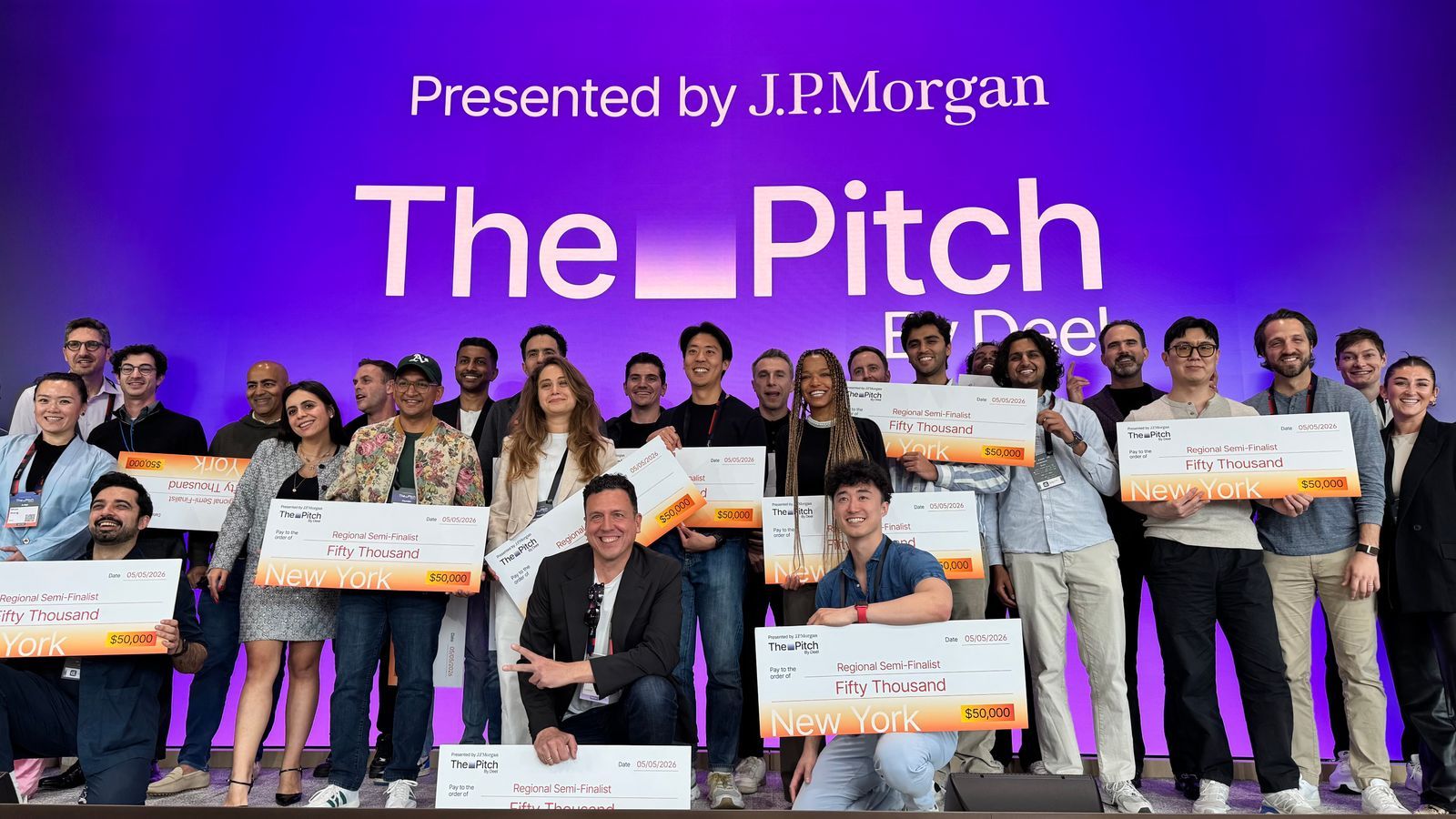
Hatch won the New York regional final of The Pitch by Deel. The prize was a $50,000 SAFE investment and a place at the Global Finale. We went, we competed, and we did not win the $1 million. We are writing this up anyway, because the interesting part was never the trophy.
What actually won the room
Every company now runs on two workforces. One of them files timesheets and sits in your HRIS. The other one arrives as a line on your cloud bill. Almost nobody can tell you what either one produced.
That is the argument Hatch made on stage, and it is not a pitch-deck argument. It is an accounting problem that got real sometime in the last eighteen months and that most leadership teams are still answering with a guess. Headcount is measured. Agent spend is measured. Output per person, across both, is not measured anywhere.
When everyone has access to the same models, the difference between two companies stops being the tooling and starts being what their people bring to it. Judgment, taste, context, the decision somebody made at 9pm that nobody logged. That is the thing Hatch is built to make visible, and it turns out to be the thing a room full of investors wanted to talk about afterwards.
What Hatch won
- First place at The Pitch by Deel, New York regional final
- A $50,000 SAFE investment, the published prize for regional winners
- A place at the Global Finale, held on 18 May 2026
We competed at the Global Finale and did not place. Worth saying plainly rather than letting a headline imply otherwise.
About The Pitch by Deel
The Pitch is Deel's global seed-stage tournament, run from February to May 2026 across seven cities, with regional winners taking a $50,000 SAFE and the Global Finale carrying a prize of up to $1 million. Reporting on the programme puts the field in the tens of thousands of startups. Deel itself describes the initiative as a programme to find, fund and accelerate early-stage, category-defining companies.
Why this one mattered to us
Pitch competitions are mostly theatre, and founders know it. This one was useful for a narrower reason: it forced the argument down to a few minutes in front of people with no reason to be polite. If the thesis does not survive that, it does not survive a CFO either.
It survived. The questions afterwards were not about the product. They were about whether companies would admit they cannot currently answer the question. That is the right thing to be arguing about.
If you are carrying the output of a team that now includes agents, and you cannot say what either half produced, that is the problem Hatch exists to solve.